High-Performance Resin Catalog
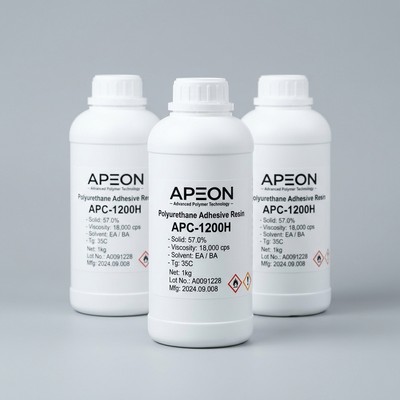
Specialty Urethane Resin
High flexibility, excellent tack, and optimized formulations engineered for next-generation flexible electronics, including FPCB lamination and low-temperature ACF bonding.
Chemistry of ACF & Polyurethane Binder Systems
Anisotropic Conductive Film (ACF) is the standard material connecting driver IC micro-electrodes to glass panels.
1) Thermocompression Flow Stage: Under thermocompression bonding pressure, the polyurethane binder undergoes rapid viscous flow for complete gap-filling of microscopic wire trenches. Storage modulus (G′) control is vital to ensure optimal conductive particle trapping and immobilization.
2) Curing & Sealing Stage: Rapid crosslinking of acrylate end-groups forms a 3D network locking the conductive particles in place. The cured elastomer absorbs mechanical stress and reduces ingress of environmental humidity and ions, contributing to corrosion resistance and interconnection reliability.
A. Reactive Urethane-Acrylate Lineup
Excellent radical curing rates and adjustable crosslinking density, ideal for fast-cure ACF formulation and hybrid UV/thermal coatings.
| Grade | Solid (wt%) | Viscosity (cP/25°C) | Diluent Solvent | Acrylate Functionality | Tg (°C) | Flowability (80°C) | Key Properties & Application |
|---|---|---|---|---|---|---|---|
| APC-1000 | 65.0 ± 2.0 | 6,000 ± 3,000 | EA / BA | 2 | 30 | ◎ | High flowability, ultra-fast radical curing, for low-temperature ACF formulations. |
| APC-1101 | 57.0 ± 2.0 | 18,000 ± 7,200 | EA / BA | 2 | 35 | ○ | Standard ACF base resin, optimal balance of peel strength and flowability. |
| APC-1102 | 58.0 ± 2.0 | 13,000 ± 5,200 | EA / BA | 1 | 25 | ○ | High flexibility and flow profile, optimized for thin display modules. |
| APC-1105 | 56.0 ± 2.0 | 12,000 ± 3,000 | EA / BA | 2 | 45 | △ | Strong initial tack and interfacial adhesion, well-suited for humidity-reliability applications. |
| APC-1150 | 50.0 ± 2.0 | 7,000 ± 2,000 | EA / BA | 2 | 90 | △ ~ X | Specialty grade featuring high hardness and elevated Tg with excellent heat resistance. |
| APC-2201 | 60.0 ± 2.0 | 5,000 ± 2,000 | MEK / BA | 2 | 60 | ◎ | Ultra-high flow, designed to maximize conductive particle capture efficiency. |
| APC-1301 | 57.0 ± 2.0 | 13,000 ± 4,000 | EA / BA | 2 | 50 | ○ ~ △ | Excellent fracture toughness and mechanical strength, good compatibility, for high-reliability ACF. |
| APC-1303 | 62.0 ± 2.0 | 5,000 ± 2,000 | EA/MEK/BA | 2 | 65 | △ | High modulus, low shrinkage during curing, suitable for hard coatings. |
* Resin flowability symbols: ◎ (Excellent), ○ (Good), △ (Moderate/Low), X (Non-flow/Shape retention), Solvent abbreviations: EA (Ethyl Acetate), BA (Butyl Acetate), MEK (Methyl Ethyl Ketone), PGMEA (Propylene Glycol Monomethyl Ether Acetate), Functionality: acrylate end-group count (1–2)
B. Non-Reactive Urethane Polymer Lineup
Utilizes high molecular weight chains to aid film formation, providing elastomeric behavior and outstanding bending reliability.
| Grade | Solid (wt%) | Viscosity (cP/25°C) | Diluent Solvent | Terminal Group | Tg (°C) | Flowability (80°C) | Key Properties & Application |
|---|---|---|---|---|---|---|---|
| APC-6000 | 40.0 ± 2.0 | 9,000 ± 3,000 | EA / BA | - | 10 | △ | Lamination adhesive for flex circuits, stress absorption, high flexibility. |
| APC-6100 | 30.0 ± 2.0 | 7,000 ± 2,000 | EA / BA | - | -5 | △ | Low Tg grade for extreme low-temperature flex circuits and automotive sensors. |
| APC-6200 | 30.0 ± 2.0 | 14,000 ± 5,000 | PGMEA | - | 35 | △ ~ X | Thermally stable adhesive, strong bond with PI and PAI coated substrates. |
| APC-6300 | 40.0 ± 2.0 | 1,000 ± 500 | MEK / BA | - | 40 | ○ | Low viscosity, high tack, suitable for thin-film coating formulations. |
| APC-6400 | 32.0 ± 2.0 | 1,600 ± 600 | MEK / BA | Carboxyl / Hydroxyl | 45 | △ ~ X | Containing carboxyl/hydroxyl groups, crosslinkable with isocyanates for strong bonds. |
* Resin flowability symbols: ◎ (Excellent), ○ (Good), △ (Moderate/Low), X (Non-flow/Shape retention), Solvent abbreviations: EA (Ethyl Acetate), BA (Butyl Acetate), MEK (Methyl Ethyl Ketone), PGMEA (Propylene Glycol Monomethyl Ether Acetate), Functionality: acrylate end-group count (1–2)
Urethane Customization Design Parameters
1. Polyol Backbones Selection
Polycarbonate diol backbone is selected for water resistance and ultimate tensile strengths. Polyether glycol backbones are chosen for soft properties and extreme low-temperature flexibility.
2. High-Elasticity Binder Formulation for Silicon Anodes
High-elasticity and high-adhesion urethane properties are precisely tuned to suppress the ~300% volume expansion of high-capacity silicon anodes during cycling and prevent current collector delamination. Polyol backbone, NCO/OH stoichiometric ratio, and dispersion stability are key design variables. (Available as custom grades.)
One-Stop Custom Synthesis R&D Process
Spec Meeting
Receive property requirements
Structure Design
Predict monomer ratios
Lab Synthesis
1–5 L reactor synthesis with GPC QC
Pilot Scale-up
50–100 L pilot scale-up with heat-transfer monitoring
Client Testing
Lamination and reflow/reliability evaluation
Mass Production
OEM partner mass production